
Transition award to gain a new perspective: from neuroscience to biomechanics - Luke Cleland
As I neared the final submission of my PhD thesis into the neuroscience of tactile processing, I found myself thinking about different perspectives on my research. While I had investigated both the input to, and output from, the tactile system during my PhD, there was a step missing: what is happening to the skin, that leads to the activation of tactile receptors?
This led me to apply for a Flexible Supplement in the form of a Transition Award, to investigate how the skin is deforming during natural behaviours such as walking, where tactile feedback is essential to maintain balance. I worked with Prof. Claire Brockett to employ a biomechanical perspective using Digital Image Correlation in MATLAB – a programming language I had not used previously.
The discussions with Prof. Brockett and her students afforded me the opportunity to understand how research stemming from very different perspectives can come together to create a more complete picture of the sensory feedback pipeline.
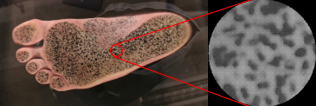
During this placement, I was fortunate enough to receive training on new experimental techniques, that allow for the skin to be tracked during movement. By applying a speckle pattern to the sole of the foot, and recording the skin as participants walk or stand on a glass platform, it is possible to track how the skin moves at a high resolution. I also received an introduction to Digital Image Correlation, which will be used to analyse this data in the future.
As more data is collected in Sheffield, a full characterisation of the magnitude, and locations, of shear forces acting at the foot sole will be conducted. Such an investigation, with a discussion from both biomechanical and sensory perspectives, will demonstrate the importance of multidisciplinary investigations within science.
This new insight into how the skin behaves during gait has also contributed to the awarding of a Postdoctoral Scholar position at the University of Guelph, Canada. Here, among other things, I will implement shear stimulation to the foot sole, in line with the magnitudes measures in my placement, to investigate the responses of tactile mechanoreceptors, while recording from the peripheral nerves using microneurography.
I would recommend that students apply for Flexible Supplements, to expand their awareness of related and parallel fields and to increase their skillset. This experience will help you both as a scientist, and will help you when looking at future directions, regardless of whether that is in academia or elsewhere.


Comments